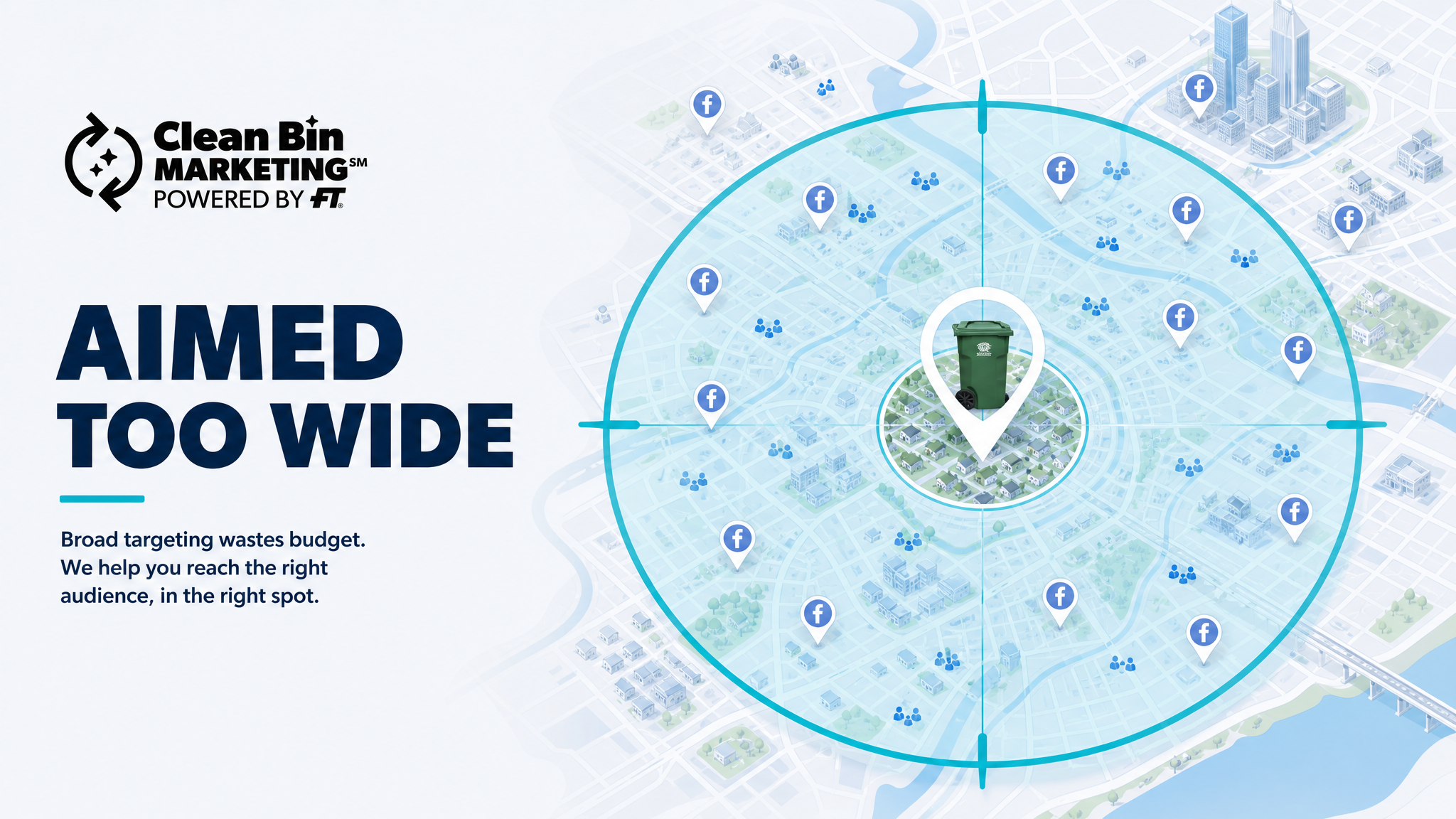
Most bin cleaning Facebook ads are pointed at a whole county when the business itself runs on a handful of subdivisions. You set a 25-mile radius because it felt ambitious. It was just expensive. You’re paying to reach people 40 minutes past your last stop. Bin cleaning Facebook ads start working the day the circle on the map shrinks to match the streets your truck already covers.
Why Bin Cleaning Facebook Ads Miss the Houses Next Door
Search and social do opposite jobs. Somebody typing “bin cleaning near me” has already decided. Nobody opens Facebook hoping to find you, so the ad has to put the problem on screen before it makes any offer, and it has to land in front of people you can physically reach on a Tuesday morning.
Now the geography. A 25-mile circle around your shop can cover 400,000 people. On a good day maybe 8% of them live somewhere a stop pays for itself. A bigger budget doesn’t fix that ratio, it just buys more of the wrong impressions faster.
Flip it around. Say you clean five houses on Willow Creek Drive every third Thursday. The other 30 houses on that same street are the cheapest customers you will ever sign: no new drive time, no new pickup day, no extra mile on the odometer. Adding them changes nothing about your morning except the deposit.
That’s the real job here. Facebook isn’t a billboard for your brand, it’s a way to knock on 30 doors at once without leaving the cab.
Eight Steps to Aim Bin Cleaning Facebook Ads at One Subdivision
Run these in order. Jumping to the budget question is how the money evaporates.
- Start where the truck already parks. Pick a neighborhood with five or more existing customers. You know the route, the day, and the drive.
- Pull the radius in. Meta lets you drop a pin and tighten the circle to about a mile. A one to three mile ring around a live cluster outperforms a countywide blast every time. ZIP code targeting is the fallback when the streets don’t fit a circle.
- Put the dirty bin on screen first. Close up, natural light, real bin. Seven words of overlay text at most. Save the offer for frame two.
- Price the plan, not the wash. “$19 a month, we show up every month, you stop thinking about it” beats “$45 one-time clean.” One buys a customer, the other buys an afternoon.
- Name the street. “We already clean bins on Willow Creek Drive” outperforms any headline you could write. Proof of proximity is the whole pitch.
- Match the landing page to the ad. Same neighborhood name, same price, form above the fold. Send that traffic to a general homepage with six menu links and you’ll lose most of it before the form loads.
- Spend small and hold still. Twenty dollars a day on one neighborhood for two weeks teaches you more than $500 scattered across three counties. Read it, then rerun the winner one subdivision over.
- Retarget the maybes. Most homeowners need three or four looks before they book. A cheap audience of past site visitors keeps you in front of them for pennies.
If you build creative around customer photos or testimonials, keep it clean under the FTC’s rules on endorsements and reviews: real reviews, no incentives hidden from the reader, no cherry-picking that misleads. Stock before-and-after shots eventually cost more than they bring in.
How Specialized Marketing Fuels Growth
Generic agencies optimize the wrong number on this account type. They’ll hand you a report showing an $18 cost per lead and call it a strong month. But an $18 lead 22 miles out is worth less than a $40 lead three doors from a stop you already make. Drive time never shows up in a standard ads dashboard. It’s your biggest cost.
That’s the logic behind how we build social media ad campaigns for bin cleaning operators: audiences drawn around live customer clusters, creative built on the subscription price, and reporting that tracks where each new customer lives. The organic side matters too, because homeowners check the page before they book a stranger to come handle their trash. A managed social presence with recent photos and answered comments raises the conversion rate on every dollar of ad spend behind it.
Frequently Asked Questions
Q: What should I budget to start? Fifteen to twenty-five dollars a day on a single neighborhood for two or three weeks is usually enough to learn something real. Spend less and the data is noise. Spend more before you know which creative works and you’re paying tuition.
Q: Should I run Facebook or Google Ads first? If your phone rings when people search, Google captures demand that already exists and generally comes first. Paid social creates demand and tightens the map. Operators with trucks running under capacity in neighborhoods they already serve often get more from social.
Q: Can I just boost a post instead? Boosting optimizes for engagement, which is the wrong goal here. You want the campaign objective set to leads or conversions, with the radius and the offer under your control. Same money, different instructions.
Shrink the Circle Before You Raise the Budget
Operators who win with bin cleaning Facebook ads aren’t better marketers than you. They just stopped treating the platform like a billboard and started treating it like a map: one subdivision, one honest photo, one subscription price, then the same thing on the next street over. Small circles, repeated.
If your ads are pulling scattered one-time cleans from the far edge of your service area, have our team look at the setup. We’ll show you where the spend is leaking and what it takes to point it at the neighborhoods your truck already drives through.