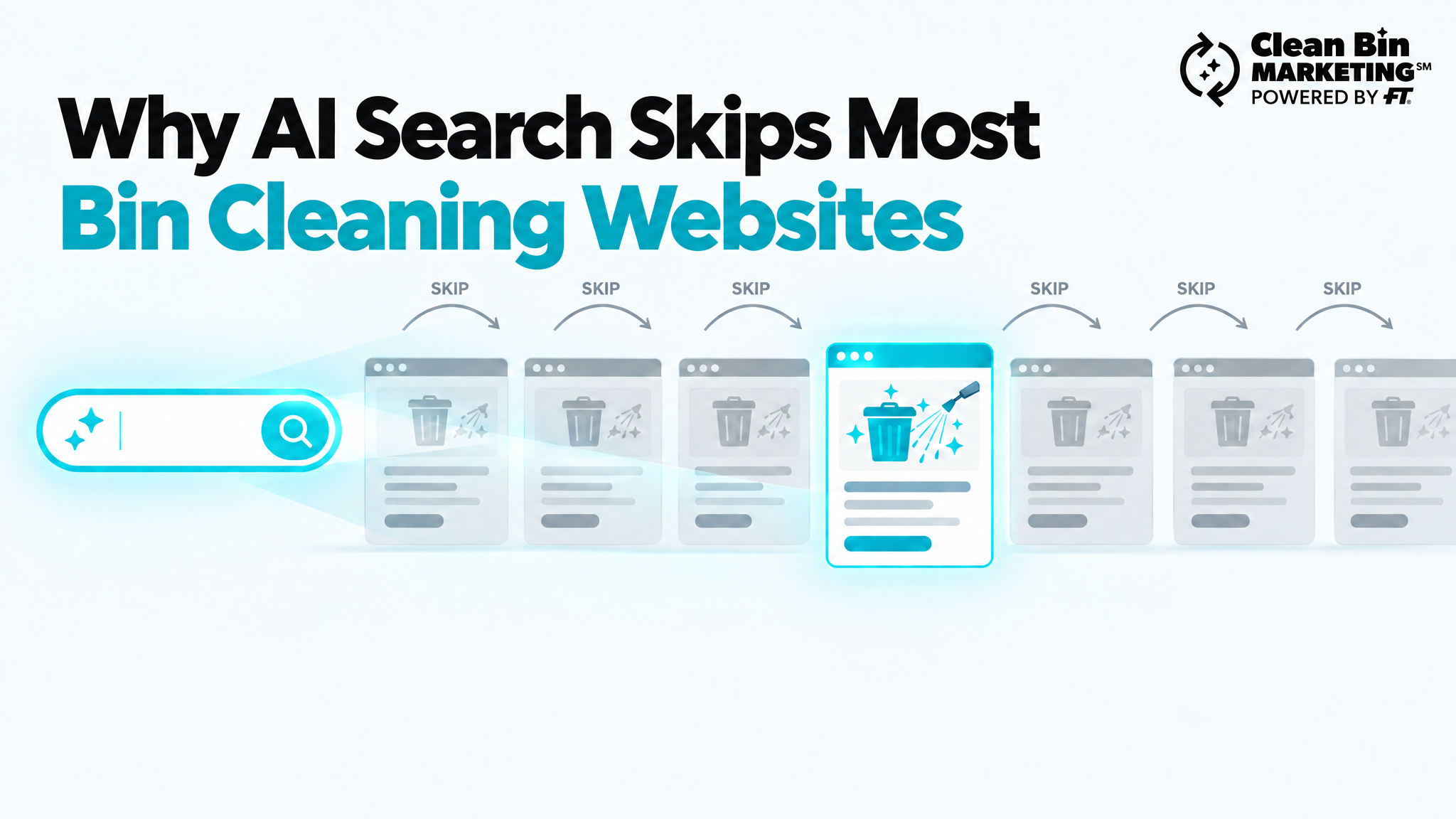
AI search is now answering the question your best leads used to type into Google. A homeowner asks ChatGPT or Google’s AI Mode who cleans trash bins in their town and what it costs, and gets back two or three company names. Yours isn’t one of them. The tool picked from facts it could read on a website, and most bin cleaning sites don’t give it many.
What AI Search Reads on a Bin Cleaning Website
These tools don’t see your truck wrap or your before-and-after reels. They read text. When someone asks a detailed question, Google’s AI features run what it calls a “query fan-out”: several related searches at once (price, service area, frequency, reviews) stitched into one answer. Each of those smaller searches needs a page that answers it in plain words.
Here’s where most operator sites fall apart. The price lives inside a booking widget. The service area is a map image with no town names written out. The FAQ is a graphic. A human can click around and piece it together. A crawler sees a logo, a hero photo, and a “Get a Quote” button.
Picture two companies 12 miles apart. One has a page that says, in plain sentences, “We clean bins in Gilbert, Chandler, and Queen Creek every four weeks, starting at $25 a month, on the day after your trash pickup.” The other says “Fresh bins, happy homes.” Only the first one can be quoted.
Google is direct about this. Its guidance on how AI features in Google Search choose and show websites says there’s no special markup, schema, or AI text file required. Pages need to be indexed, crawlable, and carry their important content in text form. That’s good news. It means the fix is the same work that already wins local rankings, done with more precision.
Seven Fixes That Get Your Company Named in AI Search
Work through these in order. Most take an afternoon, not a rebuild.
- Put your price in plain text. A sentence like “Monthly service starts at $25 for one bin, $35 for two” is quotable. A price hidden behind a quote form isn’t. If pricing varies by town, state the range.
- Write out every town and neighborhood you serve. Not a map graphic. Text, in a list, on a page linked from your main menu. Add the timing logic too: “We clean the day after your city collects.”
- Answer the five questions homeowners always ask. How often, how much, where does the dirty water go, do I need to be home, and can I cancel. Give each one its own heading and a two or three sentence answer in text, not inside an image or a video.
- Make your Business Profile match your site exactly. Same name, phone, service area, and hours. Google’s guidance on AI features specifically calls out keeping Business Profile details current. Mismatches make you look like two different companies.
- Keep structured data honest. If your schema markup says you serve 14 cities, your visible page text should name the same 14. Google wants markup that matches what a visitor can read.
- Earn reviews with specifics in them. A review that says “they clean our bins every month in Queen Creek and the smell is gone” gives an AI summary something real to repeat. Ask happy subscribers to mention their neighborhood and their plan.
- Check that nothing blocks crawlers. Some site builders and security plugins block bots by default. Run the URL Inspection tool in Search Console on your homepage and service area page. Ten minutes. If Google can’t crawl a page, it can’t cite it.
Skip anyone selling you a special “AI file” add-on. Google says you don’t need one.
How Specialized Marketing Fuels Growth
Generic agencies are pitching “AI optimization” as a brand-new line item. Most of it is relabeled SEO with a higher invoice. What a bin cleaning site needs is narrower: route towns written in text, subscription pricing stated plainly, pickup-day timing, and FAQ answers written for someone standing next to a smelly bin in July.
That’s the structure we build into every bin cleaning website design we launch, and it’s the core of our SEO packages for bin cleaning companies. We already know which questions homeowners ask in March versus November, which towns in a market deserve their own page, and how a $25 monthly plan should be worded so it reads as a subscription, not a one-time wash. Same work, two payoffs. You get stronger classic rankings and a better shot at being named in AI answers.
Frequently Asked Questions
Q: Do I need a separate strategy for ChatGPT and Google’s AI? A: Not really. Different tools pull from different sources, but they all reward the same thing: clear, crawlable facts about who you are, where you work, and what you charge. Get those right on your site and Business Profile first.
Q: How do I know if AI search is sending me leads? A: Google counts AI Overview and AI Mode clicks inside your normal Search Console performance data, so they won’t show up as a separate line. Ask every new subscriber how they found you, and add “ChatGPT or another AI tool” as an option on your booking form. Within one season you’ll have a real number.
Q: Will these changes hurt my regular Google rankings? A: No. Every item on the list above also helps traditional local search. You aren’t choosing between the two.
Make Your Site Easy for AI Search to Quote
AI search won’t replace the map pack overnight, but it’s already shaping which two or three bin cleaning companies a homeowner calls first. The operators who get named aren’t always the biggest. Their websites state prices, towns, and schedules in words a machine can repeat. Plain words win.
The slow season is the right window to fix this, before spring searches spike and every competitor starts paying attention. If you’re not sure what an AI tool can read on your site right now, talk with our team about a website review. We’ll show you which facts are missing, which pages may be hidden from crawlers, and what it takes to get your company into the answer.