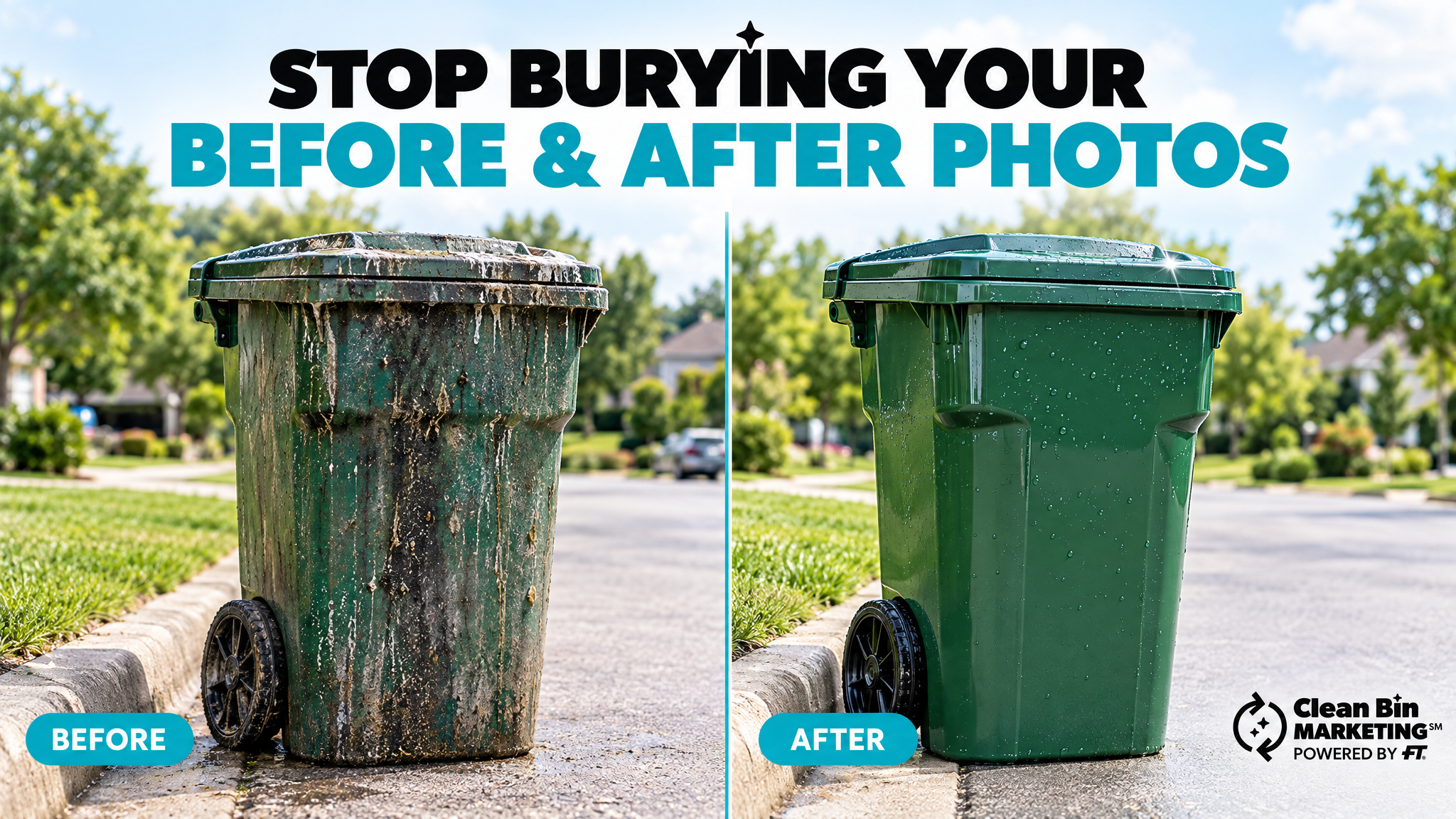
Your crew opened a bin last July that made the whole truck go quiet. Pests under the lid, a black crust on the floor, the works. Somebody snapped a bin cleaning before and after shot, it got posted to Facebook once, and then it disappeared. That photo was the best sales pitch you had all month. It deserved a better home.
Why Bin Cleaning Before and After Photos Do the Selling for You
Most homeowners have never thought about the inside of their trash can. They roll it to the curb, hold their breath, and move on. Then they see a photo of a bin like theirs, crusted and crawling, next to the same bin scrubbed clean. Now they get it.
That’s the job these photos do. They make a problem people ignore impossible to ignore, and they prove you can fix it. No headline does that as well.
The trouble is where they end up. For most operators, the camera roll is where good photos go to die. A few get posted on social media, slide down the feed in a day, and never get seen again. Meanwhile, the website still runs stock photos of a smiling family and a spotless bin that came from a photo library.
A homeowner in your best subdivision lands on your site from a Google search. If the first thing they see is a real bin from a street near theirs, you’ve earned some trust before they read a word. If they see stock art, you look like every other company in the results.
Smell is the one thing a photo can’t show. Use the caption for that.
Build a Bin Cleaning Before and After Library You Can Use All Year
A pile of random phone shots won’t do much. A small, organized library you can pull from every week will. Here’s how to set one up.
- Pick two or three “photo stops” per route day. Not every bin needs a picture. Ask the crew to grab the worst ones. Say they shoot three pairs a day, four days a week. That’s roughly 50 usable pairs a month, more than enough to feed your website, ads, and Google profile.
- Shoot both photos the same way. Same angle, same distance, lid open, looking down at the floor of the bin. Shoot in daylight when you can. A matched pair is far more convincing than two random shots.
- Keep addresses and faces out of the frame. House numbers, license plates, and kids in the driveway don’t belong in your marketing. If you want to show the neighborhood, name it in the caption instead.
- Sort them by area and season. A shared folder with subfolders like “Maple Ridge, summer” makes it easy to match photos to a page or an ad later. Summer photos with maggots belong in your June and July ads. Winter photos with frozen gunk work in the off season.
- Don’t touch them up. Light cropping is fine. Heavy filters and edits aren’t. Google’s own Business Profile photo guidelines ask for images that are in focus, well lit, and free of significant alterations or excessive filters.
Where the Photos Should Live
Once the library exists, put it to work in places that stay visible.
- Your homepage and service area pages. Put a real pair near the top, close to the booking button. On a page for a specific neighborhood, use a photo from that neighborhood. A website built for bin cleaning companies should make this easy to swap out each season.
- Your Google Business Profile. Add fresh pairs every few weeks. Photos on your profile show up right where people compare local companies.
- Your paid ads. A gross “before” stops the scroll. The clean “after” gives the payoff. Rotate pairs so the same image doesn’t run for months, and pair each ad with a page that shows more of the same. Strong social media ads are built around this kind of real proof.
- Your emails and texts to current customers. A quick “here’s what we pulled out of bins on your street this month” note reminds subscribers why they pay you.
How Specialized Marketing Fuels Growth
A general agency will tell you to “post more content.” That’s not a plan. They don’t know that a July maggot photo hits harder than a January one, or that the best proof is a bin from the same street as the person searching.
Clean Bin Marketing works only with bin cleaning companies. We build the websites, ads, and email campaigns that turn your crew’s photos into proof homeowners can see before they book.
That focus matters because your marketing is tied to your routes. Photos, pages, and ads should all point at the neighborhoods where your truck already drives.
Frequently Asked Questions
Q: Can I use bin cleaning before and after photos from another company or a stock site?
A: Don’t. Using someone else’s photos can break copyright rules, and it misleads customers about your work. Your own photos, even imperfect ones, build more trust.
Q: Do I need a customer’s permission to post a photo of their bin?
A: It’s smart to ask. You can also add a line to your signup terms that covers photos. Keep house numbers and people out of the shot either way.
Q: How often should I add new photos to my website?
A: Refresh the main ones at least once a season. Summer photos look out of place in December.
Put Your Best Proof Where People Will See It
You already have the content. Your crew creates it every route day. Bin cleaning before and after photos are the clearest proof that your service works, and they belong on your website, your Google profile, and your ads, not lost on a phone.
Start with the worst bin you clean this week. Shoot it right, save it, and use it.
If you’re not sure whether your website and ads are showing off your work the way they should, Clean Bin Marketing offers a free, zero-obligation consultation. We’ll look at what you have and where real proof would make the biggest difference. Start your free consultation here.