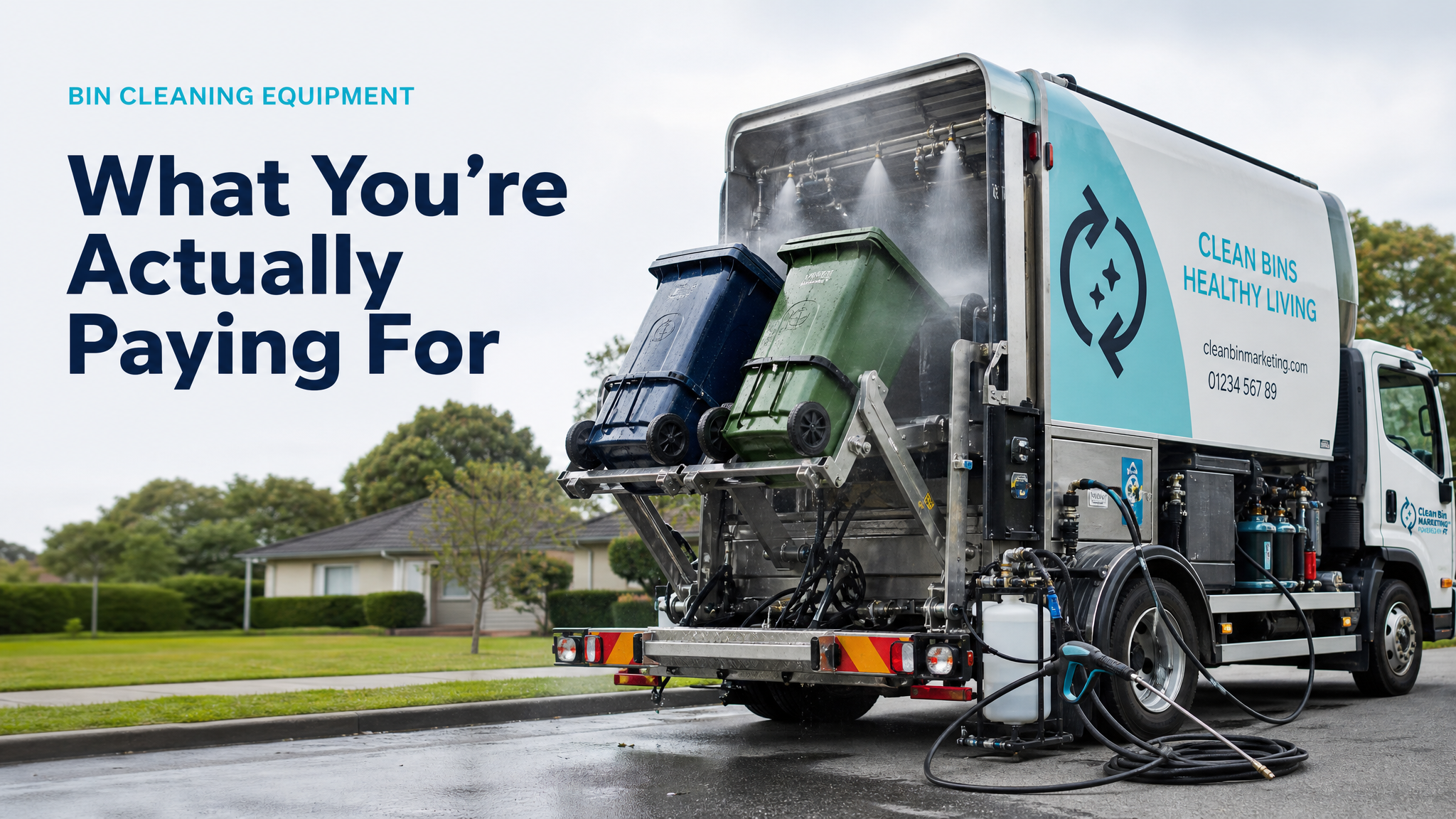
Ask three suppliers to quote you bin cleaning equipment and you’ll get $8,000, $32,000, and $110,000 for what looks like the same machine. That spread stalls more new operators than any other decision in this business. The markup isn’t the reason. A rig is a stack of separate components, and the quotes differ because the stacks differ.
What’s Actually Inside a Bin Cleaning Equipment Quote
Nobody sells you “a bin cleaner.” They sell you nine or ten parts bolted to a frame. Price each one and the mystery disappears.
Here’s the typical component breakdown, with realistic parts pricing:
- Lift and tipper arm: $2,500 to $6,000. Manual tipping is cheaper and slower, and it’s the first thing your back complains about.
- Wash head and spray manifold: $3,000 to $8,000. This is the piece that decides your seconds per bin.
- Pressure pump: $1,200 to $3,500 for a unit in the 3,000 to 4,000 PSI range at 4 to 8 GPM.
- Water heater or burner: $2,000 to $5,000. Hot water at 180 degrees is what breaks down grease and kills odor.
- Fresh water tank: $400 to $1,200 for 200 to 500 gallons.
- Reclaim tank and filtration: $800 to $2,500. Not optional in most municipalities.
- Power source: $1,500 to $4,000 for a generator or hydraulic setup.
- Plumbing, reels, hoses, fittings: $600 to $1,500. Always underestimated.
- Trailer chassis: $3,000 to $7,000 for a dual-axle frame rated to carry a full water load.
Now the tiers make sense. A cold-water, manual-tip setup with no reclaim lands around $5,000 to $10,000. A hot-water trailer with a powered lift and reclaim runs $20,000 to $50,000. A full truck-mounted build sits north of $90,000.
The trap is buying the bottom tier to save cash, then discovering your cycle time is three times longer than a competitor’s. Slow bin cleaning equipment doesn’t just cost you minutes. It caps how many stops a route can hold, and route capacity is the whole business.
How to Price Bin Cleaning Equipment Without Overbuying
Overbuying is just as expensive as underbuying. Work through this order before you sign anything.
- Set your target seconds per bin first. Everything else follows from it. If you want under 60 seconds per cart, you need hot water and a powered lift. If you’re fine at two minutes on a small starter route, you can defer both.
- Size fresh water to your longest route, not your average one. A mid-shift refill can cost you 45 minutes of drive time. Count your worst day, then add 20 percent.
- Confirm your reclaim requirement before you spec the tank. Wash water reaching a storm drain is a regulated discharge under the framework described in EPA’s summary of the Clean Water Act, and cities layer their own rules on top. Get your local answer in writing. Retrofitting reclaim later costs far more than building it in.
- Price the build-versus-buy gap honestly. Sourcing parts yourself can save 30 to 40 percent on a trailer. It also costs 80 to 150 hours of your time and gives you no warranty and no single phone number when the burner quits in February. Build your own if you’re already a fabricator. Buy turnkey if you’re not.
- Ask for an itemized quote, not a package price. Any supplier who won’t break out the pump, burner, and reclaim separately is hiding where the money went.
- Budget consumables and wear parts as an operating line. Nozzles, seals, hoses, and deodorizer are small per bin and meaningful per year. Set aside a monthly reserve from day one.
- Talk to your accountant about depreciation before year end. The IRS explains in Topic 704 on depreciation that a Section 179 election can let you recover qualifying equipment cost in the year you place it in service, subject to limits. Timing a purchase around that is worth a phone call.
One rule cuts through all of it: buy the cycle time you need, then stop.
How Specialized Marketing Fuels Growth
Here’s the uncomfortable part. The rig is the easy purchase: a fixed price and a delivery date. Filling it is the hard part, and it never ends.
That’s also why equipment is a weak advantage. Your competitor two towns over can buy the identical trailer next month. What they can’t copy quickly is a service area where every homeowner already recognizes your name and finds you first.
Clean Bin Marketing doesn’t sell bin cleaning equipment. We build the marketing that keeps it busy: websites, local search, email, and Google Ads targeted to real neighborhoods instead of a whole metro. Our digital marketing programs are built only for bin cleaning operators, which means we plan around route density and recurring subscribers rather than raw click volume.
Frequently Asked Questions
Q: What’s a fair trash bin cleaning machine price for a first rig? A: For a hot-water trailer with a powered lift and reclaim, expect $20,000 to $50,000 depending on tank size and whether it cleans one bin or two at a time. Cold-water starter setups run far less but limit your daily stop count.
Q: Is a bin cleaning trailer price worth it over building my own? A: Building your own saves real money on parts and costs real time in labor. If you can’t weld and plumb, a warranty and a support number are worth the premium in your first season.
Q: What bin cleaning equipment upgrade pays for itself fastest? A: Usually hot water, then a powered lift. Both attack cycle time directly, and cycle time is what determines how many stops fit in a day.
Buy the Cycle Time, Then Fill the Route
The right bin cleaning equipment isn’t the most expensive option or the cheapest. It’s the stack that hits your target seconds per bin, carries enough water for your longest day, and meets your local reclaim rules without a retrofit. Price it component by component and the decision gets simple.
Then the real work starts. If your routes have room the truck could be filling, tell us about your service area and we’ll show you where your leads are leaking. No obligation. Idle capacity is the most expensive equipment problem there is.