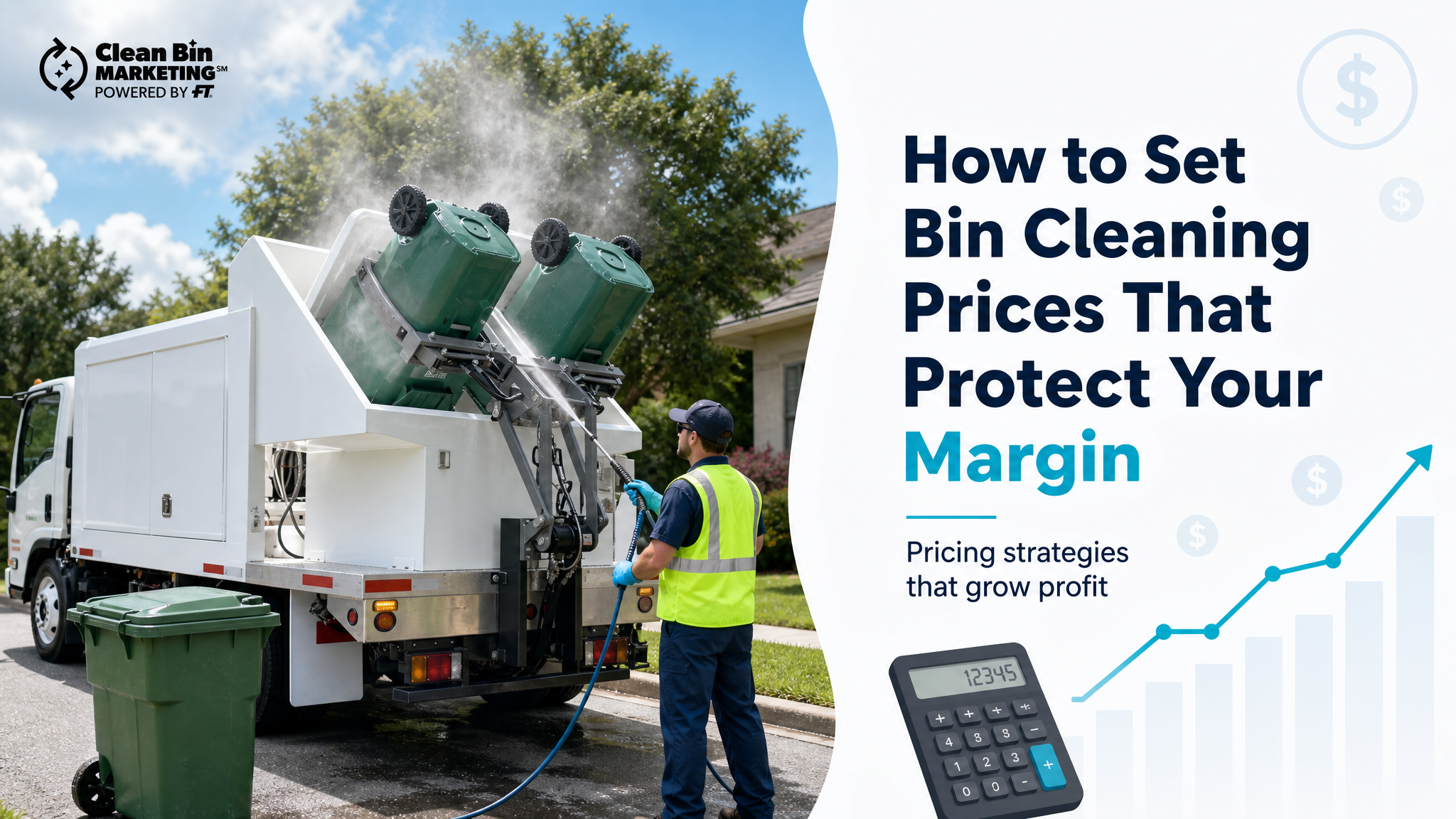
Most operators set their bin cleaning prices by checking two competitors’ sites and landing a dollar under the cheaper one. That’s how you end up washing 60 bins a day and still wondering where the money went. Bin cleaning prices should come from your own route math: drive time, water, chemical, and the churn rate you can live with. Not from whoever undercut you last spring.
What Actually Drives Bin Cleaning Prices
Your cost per bin is mostly windshield time. Water and chemical run a few cents per cart. Truck payment and insurance are fixed whether you wash 20 bins or 60. So the real variable is how many stops you can hit per hour, and that’s a function of clustering, not equipment.
Run the number for your own route. If you’re doing 45 bins in an eight-hour day at $6 net per bin, that’s $270 before you pay yourself. Push the same day to 62 bins by tightening the cluster and you’re at $372 on identical fuel and identical hours. Nothing about your pricing changed. Your density did.
This is why flat citywide bin cleaning prices quietly bleed you. A $22 monthly customer eight miles off-route costs you more to serve than a $22 customer on a street where you already have five accounts. Same invoice, completely different margin.
Two other inputs matter more than operators expect. Cart count: a three-bin household shouldn’t pay triple, but it shouldn’t pay the same as a one-bin house either. Additional carts at $5 to $8 each holds up, because the drive time is already paid for. And contract length, since annual prepay cuts churn enough to justify a real discount.
Homeowners are also less price-shy than you think. The Bureau of Labor Statistics tracks garbage and trash collection as its own consumer price line, and it rose 3.9 percent over the twelve months through July 2026. People expect this category to cost more each year.
How to Build Your Bin Cleaning Prices in Six Steps
Work in this order. Skipping step one is why most price sheets get rebuilt within a year.
- Calculate your true cost per stop. Take a full month of fuel, chemical, water, insurance, truck payment, and your own hourly wage, then divide by bins washed. That’s your floor. Most operators discover their floor is higher than they assumed.
- Price the recurring plan first, then work outward. Monthly is your anchor product. Set it where a full route pays you properly, then build quarterly and one-time off it. One-time cleans should be priced high enough that subscribing is obviously the better deal, usually $55 to $75 against a $22 to $28 monthly.
- Charge for extra carts, not extra households. Primary cart at full price, each additional at a reduced add-on. You’re already parked.
- Add a first-clean fee for badly neglected bins. A cart that hasn’t been washed in four years takes three times the cycle time. A one-time $15 to $25 initial deep clean fee is standard and nobody argues with it.
- Write your billing terms in plain language at signup. Recurring service means recurring billing, and federal rules covering subscription programs expect clear upfront disclosure and a cancellation path that’s no harder than the signup was. Clean terms also cut chargebacks.
- Schedule your increase before you need it. Build a 3 to 5 percent annual adjustment into the plan and announce it 30 days out. Operators who never raise prices end up doing it all at once, and that’s when cancels spike.
Review the whole sheet every twelve months. Fuel moves. So should you.
How Specialized Marketing Fuels Growth
Here’s what generalist agencies miss: for a route business, the pricing page and the service-area strategy are the same problem. Publishing bin cleaning prices only works if the traffic hitting that page lives in ZIP codes you can profitably serve. Otherwise you’re paying to attract customers who wreck your margin.
Specialists build it the other way around. Target the subdivisions where you already have density, then let the pricing page convert them. That means search visibility built around your service area rather than the whole metro, and a quote form that asks for an address before it quotes a price.
Price changes are a communication problem too. An email sequence announcing a modest increase 30 days ahead, with a reminder of what the service prevents, holds more accounts than a surprise line item on a card statement. Clean Bin Marketing handles the websites, search, ads, and email around your pricing. We don’t set your rates or sell equipment.
Frequently Asked Questions
Q: Should I publish my bin cleaning prices on my website? A: Yes, in almost every case. Hiding prices filters out serious buyers and fills your inbox with tire-kickers. Publish a clear starting price with an address-based quote form. If your prices are higher than a competitor’s, say why in one line: reclaim system, insured, guaranteed schedule.
Q: How do I raise prices without losing half my route? A: Small, annual, and announced. A 4 percent increase with 30 days notice and a short explanation typically costs you very few accounts. The operators who lose customers are the ones who hold rates for three years and then jump 20 percent at once.
Q: Are my prices too low if I’m fully booked? A: Probably. A solid route with a waiting list is a pricing signal, not a victory. Raise new-customer rates first, hold existing accounts a cycle, and watch whether booking speed slows.
Putting Your Bin Cleaning Prices in Front of the Right Homeowners
Good bin cleaning prices are built from your own cost per stop, anchored on a recurring plan, and adjusted on a schedule instead of in a panic. That part is arithmetic you can do this week.
The harder half is making sure the people who see those prices sit on streets where your truck already stops. That’s a visibility problem, and it decides whether a fair price sheet becomes a full route or just a nicer website.
Send us your service area and we’ll show you which neighborhoods you’re currently invisible in. No obligation. Just a straight read on where your next cluster of customers is hiding.