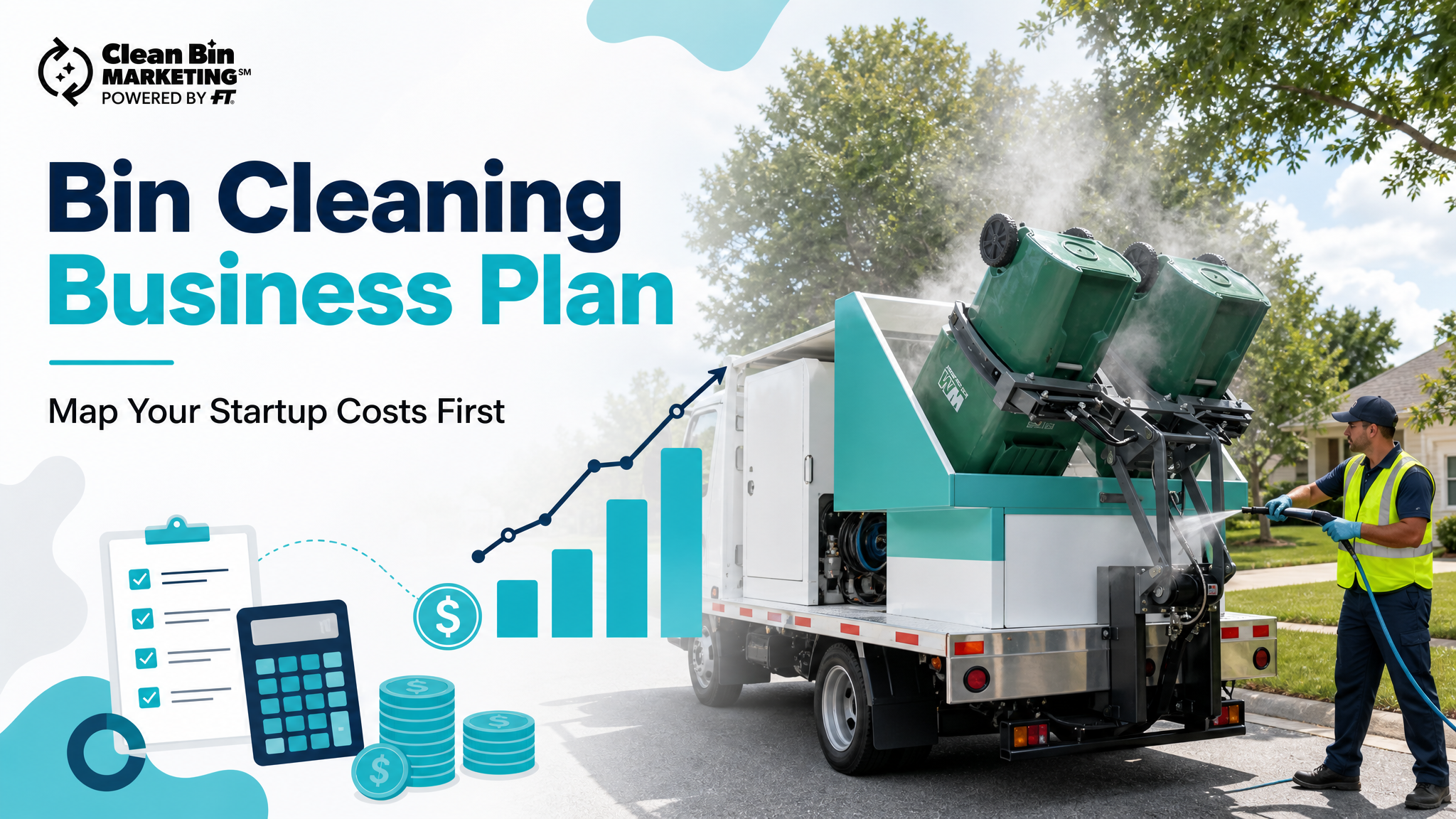
Most people jump into this trade truck-first, then write a bin cleaning business plan only when a lender asks for one. That’s backward. That plan is the tool that tells you whether your routes will actually cover the truck payment before you sign for it. Get the numbers on paper early, and the slow first winter stops being a surprise. Skip that step, and you’re guessing with real money.
What a Bin Cleaning Business Plan Really Needs
A plan for a route-based cleaning company looks different from a generic small business template. Your money moves in a specific pattern: heavy upfront gear, then thin margins that only fatten as route density climbs. Your plan has to show that curve, not hide it.
Start with the parts every lender and every honest self-check expects. The SBA’s guide to writing a business plan lists the standard sections, and they map cleanly onto bin cleaning work:
- Company summary: who you serve, which zip codes, and why recurring service beats one-time cleans.
- Market analysis: how many homes sit in your target radius, and who already services them.
- Operations: truck, water source, dump plan, and how many bins one tech clears per day.
- Financials: startup costs, monthly overhead, price per clean, and your break-even customer count.
That last line is the one most operators skip. Your break-even is not a vibe. It’s a hard number of recurring accounts, and until you hit it, every route runs at a loss. A solid plan makes that count impossible to ignore.
How to Build Your Bin Cleaning Business Plan and Price Startup Costs
Here’s a practical order for putting real startup costs for a trash bin cleaning business on paper. Work through it once, then update it every quarter.
- List the big iron. Truck or trailer rig, cleaning system, and water tank. A used trailer setup can run $8,000 to $15,000; a purpose-built truck can climb past $90,000. Pick the tier your route volume can actually feed.
- Add the small stuff that adds up. Insurance, LLC filing, a business bank account, uniforms, and signage. Budget $2,000 to $4,000 here. It’s easy to forget, and it’s real.
- Set your price per clean. Most single-bin recurring cleans land between $10 and $20 depending on region and frequency. Write down the number you’ll actually charge.
- Find your break-even. Divide monthly fixed costs by your profit per clean. If overhead is $3,000 and you net $12 a bin, you need 250 monthly cleans just to reach zero.
- Plan the lead engine. This is the line that decides whether steps one through four ever pay off. A truck without booked routes is a $90,000 lawn ornament.
Notice the pattern. Equipment is the easy part. Filling routes is the hard part, and your startup cost trash bin cleaning business math falls apart without a real plan to get customers in the door. Your website and local search presence belong in this budget, not as an afterthought. A website built specifically for bin cleaning companies is working capital, same as the water tank.
How Specialized Marketing Fuels Growth
A plan can be flawless on paper and still stall in month three. The reason is almost always the same: no steady lead flow to fill the truck. Generic marketing firms don’t understand route density, seasonal booking swings, or why a monthly subscriber is worth ten times a one-off clean.
That gap is exactly what a niche agency closes. Clean Bin Marketing works only with trash bin and dumpster cleaning operators, so the strategy already accounts for your slow January and your spring surge. Clients often aim for 20 to 50 recurring leads a month, and reaching that takes more than a phone number on a truck wrap. It takes local SEO, a site that converts, and paid search timed to demand.
We handle the full range of digital marketing built for bin cleaning operators: websites, search rankings, ads, and email that turns one-time cleans into subscribers. You run the routes. We keep them full. That split is the whole point of hiring a specialist instead of a generalist who’s still learning your trade on your dime.
Frequently Asked Questions
Q: How much money do I need to start a trash bin cleaning business? A: Plan for $10,000 to $20,000 on the low end with a used trailer rig, and well over $90,000 if you buy a new purpose-built truck. Add another $2,000 to $4,000 for insurance, licensing, and setup. Your marketing budget belongs in that total too, since routes don’t fill themselves.
Q: Do I really need a written business plan for a bin cleaning company? A: If you want financing, yes. A lender expects one. Even self-funded, a written bin cleaning business plan forces you to find your break-even customer count before you spend a dollar. That single number saves a lot of second-year regret.
Q: How long until a bin cleaning route turns a profit? A: It depends on how fast you build density. Most operators need several hundred recurring cleans a month to clear overhead, and that can take a year or more without focused lead generation. Marketing speed is the biggest lever you control.
Put Your Plan to Work
A bin cleaning business plan does two jobs. It keeps you honest about startup costs, and it forces you to treat customer acquisition as a real line item instead of a hope. The equipment math is straightforward. The routes are what make or break you.
If your plan has a solid truck and a fuzzy marketing section, that’s the gap worth closing first. Clean Bin Marketing helps trash bin cleaning owners build the lead flow their business plan assumes. Tell us about your market, and we’ll show you where your routes can grow. Start your project with our team, and let’s fill those trucks.